
When Everything Feels Unstable, Should You Still Set Goals?
Reclaiming Agency: How to Use Metrics as a Strategic Anchor in the Fog of Uncertainty
TL;DR: In volatile times, planning can feel pointless, but it’s actually a vital tool for resilience. By reclaiming your Locus of Control and separating "Future Propellers" from "Operational Vital Signs," leaders can move from paralysis to proactive agency. This approach gives teams a hopeful, concrete future to work toward, enabling clear decisions in ambiguity by measuring only what truly matters and staying responsive to change.

A lot is going on in the world right now, and thinking of goals and metrics might seem trivial - pointless even. You may be asking: “What’s the point when everything seems so unstable?”
I’m here to tell you it matters.
Research tells us that uncertainty breeds fear and helplessness when we focus on externals. The most effective way to counteract this is by reclaiming your Locus of Control.
Psychologists call the locus of control: deliberately focusing your energy and attention on what you can affect (Locus of Control). Strengthening an internal locus of control is linked to greater resilience, better problem‑solving, and more effective leadership, especially in turbulent environments. This means shifting your energy and attention toward what you can actually affect. By doing so, you don't just hit targets; you lay the groundwork for the future.
The toughest part of leadership is finding a future you want to be a part of—and striking that path with the conviction that it is worth building. I’ve always been reminded of the quote: Without a vision, the people perish. Having a vision is not a false promise; it is the belief that a potential future is not only possible but inevitable. It is hope anchored in purpose, providing a steady keel when the winds of change rush in.
Goals and metrics are the structures that enable you to build that future. Do not ignore them. Do not neglect them. Use them to build resiliency.
As a leader, anchor yourself in vision and planning. Engage with your team to define metrics, because these activities demonstrate that there is a future worth creating. Structure and active engagement in what you can control support both your progress and your well-being.
In this post, I want to lean into metrics and planning for ambiguity. Metrics are not a waste of time; they are a way to keep the future in mind and utilize your leadership to navigate uncertainty. Let’s talk about measuring what matters, embracing simplicity, and being ready for change.
Measure What Matters
The adage “you measure what matters” is a useful principle when you’re building metrics at each stage of business growth. It also means your metrics will change—and must change—to stay aligned with what actually impacts your future: shifts in markets, new opportunities, external forces, or rising complexity. Whatever the challenge, metrics are meant to adapt with the business; they are not static.
Measuring what matters means measuring what matters to the life of the business. It sounds obvious, but it’s easy to get lost in nice-to-have metrics. They look great on a dashboard, but no decisions change, no actions are taken, and nothing moves strategically. Everyone is busy, but unclear on what is actually vital to the future.

In a world of constant flux, strategy can’t be a static document; it has to move at different speeds. I think about it in four layers:
Future Gazing (15–25+ years)
This is your North Star. Long‑range macro‑trends help answer the foundational questions: Where do we want to be, and who are we becoming as an organization?Strategic Propellers (5–7 years)
In uncertainty, we translate that broad vision into a handful of targets with an adaptable lifespan. This horizon is long enough to scale meaningful change, but short enough that you can recalibrate as conditions shift.Annual Planning (up to 3 years)
These are your reality touchstones. Annual and 2–3‑year plans bridge the gap between today’s constraints and where the Propellers are trying to take you.Paving Stones (weekly / monthly)
These are your granular execution metrics—the specific actions, habits, and check‑ins that build the future one stone at a time.
Decomposing vision into action
As the pyramid illustrates, leadership is the work of decomposing vision. You take the abstract “red” tier and keep breaking it down until it becomes a “purple” daily task that someone can own this week. In the other direction, your team is constantly building the company from the bottom up—laying Paving Stones that create the momentum needed to reach those 5–7‑year Strategic Propellers.
For example, you might set a strategic goal to reduce material waste in product delivery by 20%. Across departments, this might look different:
Engineering looks for more effective ways of dividing and using resources, perhaps repurposing or selling unused materials.
Assembly focuses on error reduction, moving from a 5% error rate to 1%.
Each department may have goals that take months to implement before you even begin performance tracking. Some teams are designing and implementing solutions; others are tightening the needle and comparing how close they get in year 1 versus years 2 and 3.
The beauty is when all of this moves in concert. That’s why being clear on what matters is paramount. Narrowing your focus leads us directly into simplicity.
Embracing Simplicity
Strategic goals speak to the future, and the list should be small and tight. These goals are not about the health of the current state; they are the propellers toward the future. You need both strategy and current‑state operations, but they serve different purposes.
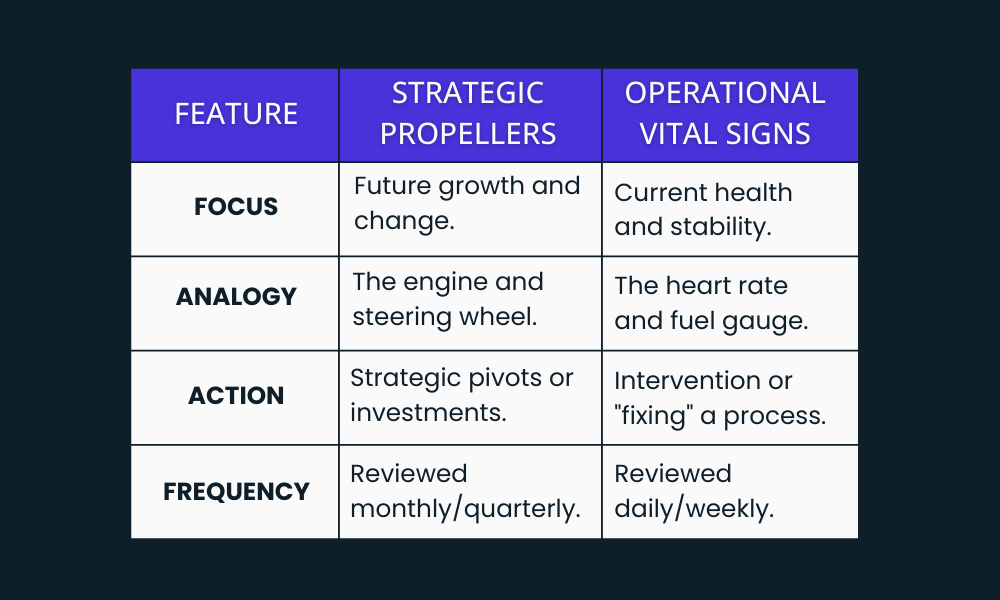
This is true whether you’re a small business or a large organization. The fear is often about loss of control. The further away you are from the action, the more tempting it becomes to conflate strategy with day-to-day operations.
Simplicity is about narrowing your focus and marshalling your energy. Priorities are about focused resources, attention, and time. Strategic goals and operational performance are both high stakes, but they are not the same thing. Keep it simple and keep them distinct—schedule time to review both.
For review meetings to be effective, the metrics you choose as leaders must be ones that lead to action: decisions, barrier removals, interventions, pivots, or even pausing or stopping activity. Define your tolerance levels up front. Metrics don’t just show data; they dictate action.
Example: If your margin on a project hits X%, what is the immediate intervention?
In addition, leaders need “flag runners”: metrics (leading) that help you anticipate issues early enough to raise a flag before goals are genuinely at risk. These are the signals that tell you when a goal may be threatened or needs to change.
This leads us into the last area: being responsive to change.
Ready for Change
In uncertain times, hesitation can creep in around starting and stopping. That hesitation is often rooted in the unknown. The fear of what you don’t know can feel bigger than what is known—let alone what you can control. It can lead to paralysis or chronically delayed action.
Metrics help bring into focus what you are in control of and how your business is reacting to change. They give you a way to move between starting, proceeding, pausing, and stopping with more confidence. Metrics enable agency in leadership and in staff—but only if they are paired with feedback and dialogue.
One of the first steps is to acknowledge and talk about uncertainty. Ignoring it is foolish and can create fissures and roadblocks. Instead, name it with your leadership team and with your staff. Invite them to be solution‑seekers and mitigators. When you have honest conversations while developing metrics, the information flows better and faster when you’re in the trenches. That small edge in timing can be the difference in making better choices.
Metrics are powerful. They can support resilience—but only when they’re part of a shared effort, and the objectives are genuinely owned. The wins and the losses belong to the whole team.
If you suspect your team is working hard but still flying blind, your metrics might be the missing link. Share this post with your leadership team and choose one area—measuring what matters, embracing simplicity, or getting ready for change—to work on together this month. And if you’d like support designing metrics your whole team can own (wins and losses included), reach out and let’s talk about a focused Metrics & Change working session tailored to your business.


