Turning Feedback from Threat to Fuel: A Leader's Field Guide
"That sucks."
That was the entire critique a teacher once gave me. Short, direct, and technically "timely," but was it credible? Helpful? Insightful? Not at all.
Here's what I actually learned from that moment:
People in authority can't always be trusted to make it safe.
Feedback isn't always helpful, but it can be harsh.
Feedback sits outside of you; it doesn't define you.
Even at 16, I knew that comment wasn't true. I wasn't exactly zen about it—what 16-year-old would be? I didn't feel crushed, either. My peers saw something different; I'd created a strong figure painting that really pushed my skills. Still, I felt stuck. The piece seemed unfinished, like that lingering hunger after a meal that didn't quite satisfy. I needed real feedback that could help me push through.
I didn't learn what feedback could be until another art class in university. We had to be critiqued. I remember how nervous I was: imagine your drawings on the wall, being discussed by a real, award-winning, museum-level artist…plus all your peers.
But when the critique happened, it was a revelation. You could dive into the problems, see your work through others' eyes, and actually improve. Sometimes you wouldn't know how to apply the critique right away, but over time, your work would get better. This process felt so different from sports, where feedback usually involves coaching, learning a technique, and practicing it repeatedly.
Art critiques seemed more public and mirrored the working world: if the outcome were less than great, you'd have to deal with it or start over. And let's be honest—starting over isn't always feasible. In these critiques, everyone was engaged, including authority figures. Offering feedback meant presenting a full picture: what worked, what didn't, and, crucially, why. Simply saying, "I like it" or "It sucks" just didn't cut it.

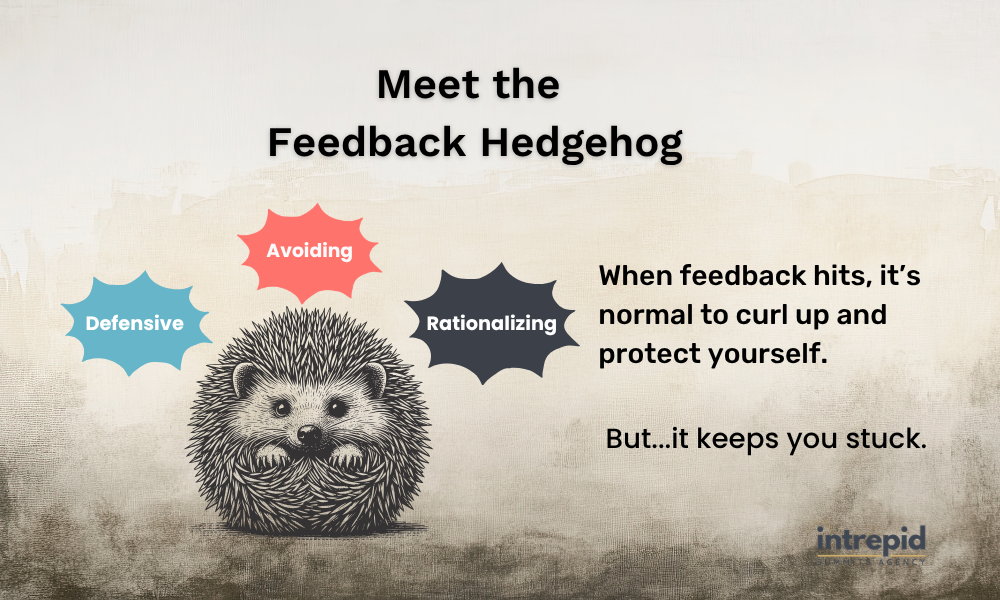
If you caught last week's post about hedgehogs, you'll remember the theme: when feedback appears at work, we often don't feel like we're in a relaxed studio; we feel like we're on stage. Our nervous systems register "threat," not "opportunity." It's understandable that in leadership roles, we can react like hedgehogs—curling up, bristling, or charging into sweeping changes just to make the discomfort go away.
I've been there, too. I know I've turned into a feedback hedgehog more times than I'd like to admit.
But if we stay curled up for too long, we miss growth opportunities. So before you overhaul your development plans or armour up, I want to share a five-step process to help you shift from a hedgehog response to choosing growth. This article is a deeper dive into that first hedgehog post, and in the next one, we'll look at practical ways to process and act on feedback without burning out or shutting down.
Step 1: Anchor in Personal Safety
"I'm not bothered."
"I don't care what others think."
"Ya, I know but…"
Feedback has been part of our lives since we first entered this world. It shapes our self-perception and how we navigate our paths, so it makes sense that it can feel uncomfortable.
And leadership asks you to be uncomfortable.
As a leader the first step is self-awareness: recognizing the world around you, seeking out feedback, and responding thoughtfully. We've all seen leaders who lack this awareness, and worse, those who have it yet do nothing. The result? Toxicity. Ignoring feedback can poison both your own well-being and that of others. This doesn't mean you become a changeling. You don't need to become someone you're not; you have the power to decide what aligns with your true self and goals.
Anchoring into personal safety means taking care of your body and mind first.
Start by noticing how feedback impacts your nervous system. High stress can make even positive feedback feel heavy. Perhaps your breathing becomes shallow, your chest or gut tightens, or your shoulders climb up toward your ears. Neuroscience tells us that our nervous systems continuously scan for signs of safety or threat, especially in social situations such as feedback conversations. Those physical sensations can distract you from truly hearing what's being said.
Understanding the body reaction will help you with the mental pivot, especially when it happens in real time. Because we often treat feedback as a measure of our self-worth, but it isn't. Feedback is simply information about the impact of your actions—your behaviors, work products, and decisions. You are not the feedback itself, even if your body reacts that way—we'll go deeper on this in Step 3.
Think of feedback as a library. You can browse, check out a book, read it, and return it. You choose what comes home with you. You may not always like how the feedback is delivered, but your worth is not on the line—no matter how it feels in the moment.
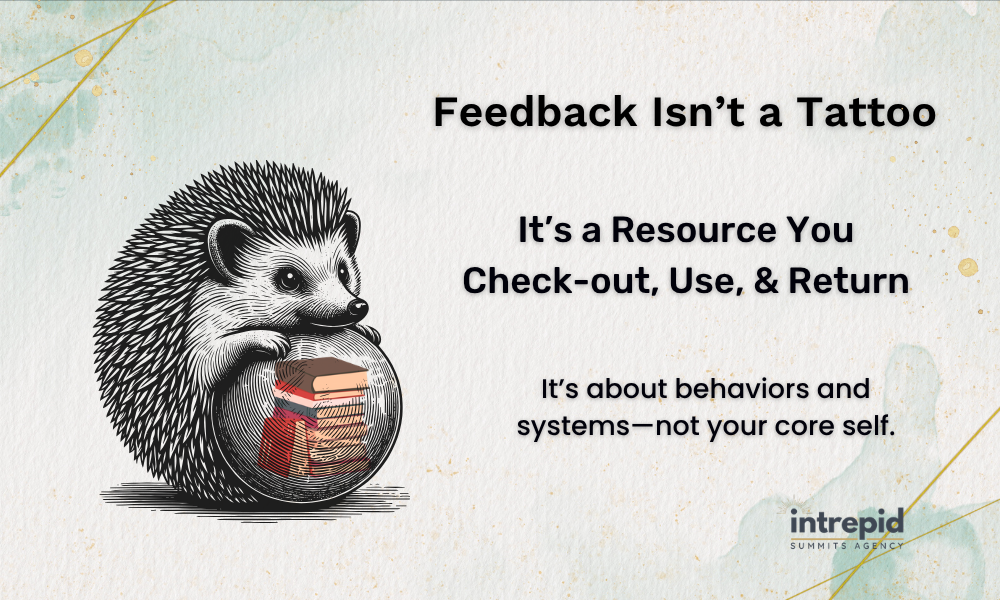
Your work here is to create personal safety: connect with the hedgehog part of you and let it know you're safe enough to uncurl, even a little.
Step 2: Face Your Inner Critic
Often, the harshest feedback doesn't come from others but from the critic in our own minds. The anticipation of feedback can amplify that voice, leading to feelings of anger, shame, or discouragement even before the conversation begins.
Confronting your inner critic helps quiet that noise:
Write down what your inner critic is saying—all of it.
Step away for a few hours or a full day.
Revisit what you wrote with a neutral lens: how much is pure emotion (fear, shame, embarrassment) and how much is a real desire for growth?
Claim the real growth areas: maybe it's listening more deeply, improving presentation skills, or building confidence in public speaking. Then deliberately look for evidence of both your strengths and your gaps.
This process can help you separate constructive feedback from unhelpful self-criticism, paving the way for a healthier interaction with feedback in the future.
By embracing feedback with an open mind, you not only foster your own growth but also create a more positive environment for those around you. Remember, feedback isn't a judgment on your worth; it's a tool for improvement.
Step 3: Focus on What, Not Who
One of the biggest barriers to growth is confusing critique with identity. In the workplace, titles, hierarchies, and closed systems can shape our sense of self, making feedback feel more tense and high-stakes than it needs to be.
This is the same principle from Step 1: feedback reflects the impact of your actions, not the core of who you are. But when identity and title get tangled up, that distinction gets harder to hold.
Learning to focus on what rather than who changes the conversation.
If someone says, "You're like this," meet it with curiosity:
"What about that makes you think that?"
"Can you share a specific example where you saw that show up?"
When you hear statements like, "You don't listen," it can feel accusatory, triggering defensiveness. This technique can help you manage that discomfort and shift into a discovery mode.
Research on psychological safety shows that how leaders respond to feedback directly influences whether team members will feel comfortable speaking up, sharing ideas, or highlighting risks.
By shifting the conversation into questions, you can move away from blame and toward discovery, modelling a psychologically safe and feedback-rich environment for your team.
Step 4: Set Your Intention
This step sits in the middle for a reason. As a leader, you've probably done some mental prep going in. But it's during the conversation—when your nervous system is activated, and your hedgehog is pacing—that you most need this reset.
Set, or reset, your intention:
Choose a word or phrase that captures how you want to show up: curious, steady, open, grounded.
And remember the purpose—the why of this conversation.
Return to that word when you feel your defences rising or the urge to retaliate, justify, or shut down.
This anchor can help you stay steady. This isn't about achieving some meditative state. It's about having the building blocks to stay aligned and purposeful in the moment. Words matter—they build our worlds. Use them to your advantage.
Your intention is your internal metronome. It helps you respond instead of react. When you hold this line, you earn more respect, deepen psychological safety, and invite more honest feedback over time.
Step 5: Refine and Seek
Having an open channel to listen is 80% of the work. From there, growth happens in how you refine and what you seek next.
Feedback conversations are not one-way broadcasts; they are collaborative. Much like an art critique, everyone contributes to a clearer understanding of what's working and what can be improved.
A few simple questions can transform feedback into a growth plan:
"What's one thing I could adjust that would make the biggest difference?"
"If I improved this by 10%, what would you notice?"
"What support or context am I missing that would help me do this better?"
Stay anchored in what you are seeking: is it growth, clarity, alignment, or a better outcome for the team? From there, consider what actions, new learnings, or experiments could provide the breakthrough you need today.
When we stop approaching feedback defensively and start meeting it with curiosity, we reclaim our power to grow. While feelings of defensiveness can still arise, they should serve as a signal: "I'm feeling threatened." This is your cue not to shut down, but to pause, breathe, and thoughtfully choose your next step.
In the next article, we'll move from receiving feedback to processing and integrating it so you can transform even tough input into aligned, sustainable change for you and your team.

If your organization is ready to transition from viewing "feedback as a threat" to "feedback as fuel," my strategic consulting and leadership workshops can help. I collaborate with senior leaders and teams to develop feedback practices that support psychological safety, clearer decisions, and healthier performance conversations—turning feedback into usable data rather than a source of bitterness or burnout. If you’d like to explore what that could look like for your team, you can schedule a working conversation with me, by booking a Strategic Call


