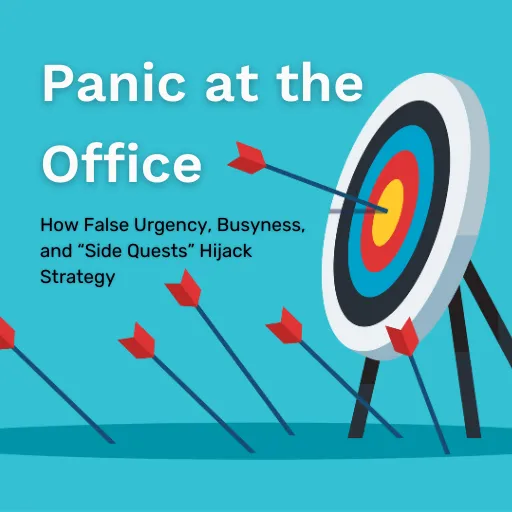
Panic at the Office: Why Emergency Culture Fails Your Strategic Priority
How False Urgency, Busyness, and 'Side Quests' Hijack Your Strategy
In my last post, Embracing the New Year: A Strategic Approach to Capacity Building, I delved into sustainable leadership. Today, let's expand on this concept by zooming in on one essential skill: prioritization.
I believe that prioritization must go beyond feelings of urgency and speed, and instead manage the business's instruments, including energy, systems, and resources. It's time to rethink what prioritization is and let go of the emergency culture that holds progress back.
In this post, I will discuss three myths that limit your growth and progress towards achieving your most important goals and how prioritization actually works in your business.
Summary: Most leaders confuse speed with progress and rely on urgency as an accelerator. Panic at the Office explores why emergency culture is a trap and how to reclaim your horsepower through true prioritization: turning chaotic activity into focused achievement.

Emergency Is Not Prioritization: 3 Myths Leaders Live Inside
Myth 1: Emergency Shows Priority
Most workplaces would describe themselves as "fast-paced," and there is cultural currency in speed. But speed is not prioritization—it often just feels like urgency, or even a constant state of emergency.
It’s important to emphasize this distinction because effective prioritization needs more than high cortisol and anxiety; it needs real horsepower. When you manufacture a sense of emergency, you are manipulating the environment to create stress. It can look like momentum because everyone is moving quickly and busily, but you are losing. You’re paying a higher price in rework, slower decisions, lowered productivity, and higher burnout rates.
Prioritization does not equal emergency or urgency:
An emergency is a serious or catastrophic disruption to regular operations (force majeure, safety incidents, shutdowns).
Urgency is a pressured effort to remedy a compromised operational level (service, product, supply, etc.).
Neither is a long-term strategy.
Myth 2: Being “Busy as a Bee”
False productivity is being constantly busy yet unable to clearly demonstrate what was accomplished or how it moved you closer to a strategic goal. I once heard an executive say he wanted to see his senior leaders looking out a window—it meant they were thinking deeply, not just reacting.
Consider what “busy” is inviting into your day: regular disruptions, false urgency, overlapping timelines, poor planning, and constant firefighting. Consider that this may be self-sabotaging at worst and self-defeating at best - either way, you've ensured that energy, systems, and resources are diluted. You are simply spread too thin.
The act of prioritization enables a singular purpose. It allows you to structure effort and resources so they predominantly reside in one focused quadrant—the true priority. Don’t be fooled by the appearance of being busy; it can be an energy sucker.
Myth 3: Are You Creeping or Subtracting?
Scope creep is the quiet enemy of prioritization. Saying yes to one more “small side quest” or a few extra bells and whistles may seem harmless, but it divides energy and resources.
When you add, you’re actively asking people to stop progress and adjust—considering new options, scenarios, and tasks. Clients may come back and request additions, and sometimes that’s appropriate. But if you, as a leader, can avoid being the source of that creep, then refrain. One of the most powerful prioritization moves is subtraction.
So What Is Prioritization?
Prioritization is marshalling energy and resources into focused goals and their supporting objectives. Focused energy minimizes disruptions and protects you and your teams from distractions and faltering progress.
It also requires stable, committed resources. To do that, you need clear markers for when to bring resources on and when to release them. There is often a misconception that prioritization is a carte blanche approach, but everything is finite, so you need defined guideposts—such as metrics—to decide what remains a priority and when things must shift.
Effective prioritization is the deliberate harnessing of your operations and resources: software, machinery, people, suppliers, and beyond, all aligned toward what matters most.
Let's Work Together
Real leadership isn't measured by how fast you run, or how many fires you put out. It is measured by your ability to harness focused energy towards what actually moves the needle. Stop managing in a state of emergency, start marshalling your resources.
If you see yourself inside any of these myths, I'd love to know which one(s); and what you're ready to let go of.
If you want help doing that without burning yourself or your team out, book a Strategic Call with me and include the words "no more side quests" in your message. Together we'll map your priorities and decide what to take off the table in the next 30 days.


